
Serving Southwest Michigan since 1978
Morton’s Neuroma Treatment in Kalamazoo, MI
That feeling like there is a pebble in your shoe, or burning between your toes that you cannot shake? Conservative care first, and surgery only when the nerve pain will not quit, right here in Kalamazoo.

It Feels Like Walking on a Pebble
If it feels like there is a small stone or a bunched-up sock under the ball of your foot that you cannot shake out, you are describing one of the most common symptoms of a Morton’s neuroma. Many people check their shoe, find nothing there, and realize the feeling is coming from inside the foot.
For others it is less of a lump and more of a burn. A hot, electric pain between the toes, usually the third and fourth, that flares when you walk and eases the moment you slip your shoe off and rub your foot. The toes may go numb or tingle. The pain often comes and goes at first, quiet for days, then back again, which is part of why people put off doing anything about it.
By the time most people look for help, they have already figured out which shoes set it off and started avoiding them. If that sounds familiar, you are in the right place.
Common signs of a Morton’s neuroma:

What Is a Morton’s Neuroma?
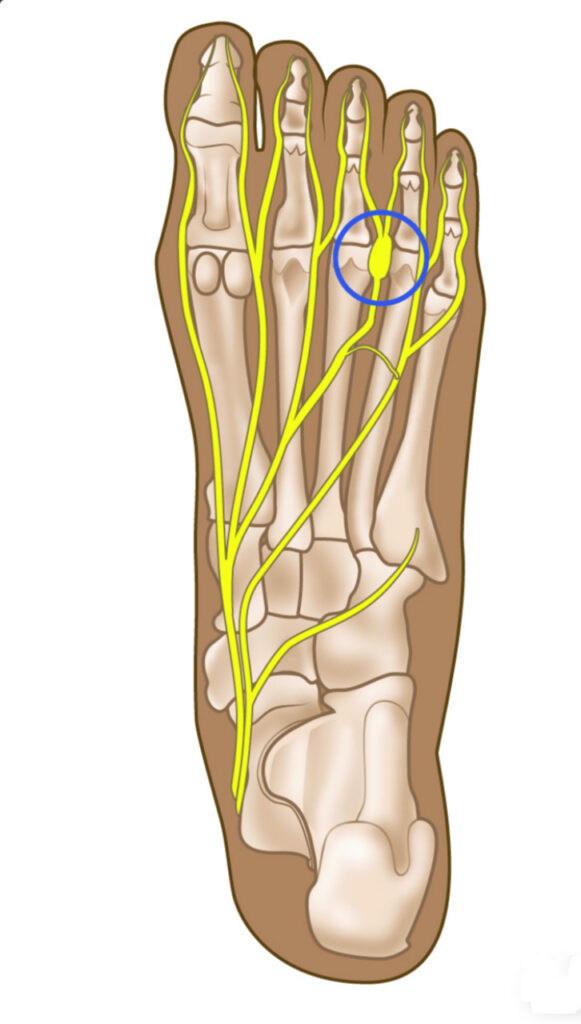
A Morton’s neuroma is a thickened, irritated nerve in the ball of your foot, most often the nerve that runs between the third and fourth toes (your doctor may call it an interdigital nerve). It is not a tumor or a growth, even though the name sounds like one. It is a normal nerve that has become swollen and sensitive from being squeezed and rubbed over time, a kind of slow nerve injury from repeated pressure.
The nerve sits in a tight space between the long bones of the foot. When it gets pinched there, again and again, the body wraps it in extra tissue to protect it. That thickening is the neuroma, and the thicker it gets, the more easily it gets pressed, which is why the pain tends to build over months rather than appear overnight.
Tight or narrow shoes, high heels, high-impact activity like running, and the natural shape of some feet, such as flat feet or high arches, all crowd that space and add to the pressure. The same crowding can go along with other forefoot problems like bunions and hammertoes. That is also why the pain eases the instant you take a tight shoe off: you are giving the nerve room again.
Conditions That Get Confused With Morton’s Neuroma
Ball-of-foot pain has more than one cause, and a few of them get mistaken for a neuroma. Telling them apart matters, because the treatments are different.
Plantar Plate Tear
A small ligament under the toe joint can stretch or tear, usually under the second toe rather than between the third and fourth. It causes pain right under the toe joint and can make the toe start to drift. It is the look-alike most often mislabeled as a neuroma. Learn more about plantar plate tears.
Capsulitis
Inflammation of the joint capsule at the base of a toe. It causes a similar ache in the ball of the foot, but without the nerve burning and numbness that come with a neuroma.
Metatarsal Stress Fracture
A small crack in one of the long foot bones. The pain is more pinpoint and worse the longer you are on your feet. Learn about fracture care.
A physical examination, X-rays to rule out a stress fracture, and sometimes an ultrasound or MRI sort these out, so the treatment matches the real problem rather than chasing the wrong one. A heel problem like plantar fasciitis sits in a different part of the foot, so burning between the toes usually points away from it.
You’ve Probably Already Tried…
Most people who come in for a neuroma have already worked through some version of this list:
These help, and for plenty of people they are enough. Taking pressure off the nerve is exactly the right first move. But when the shoe changes and the pads stop holding the pain back, or when a cortisone shot that worked great in the spring is not touching it by fall, that is the nerve telling you it needs more than offloading. That is the point where it is worth looking at the next step.
When to See a Foot and Ankle Specialist
A neuroma that flares once in a great while in your dressiest shoes is not the same as one that has taken over your daily walks. Here is when it is worth having a podiatrist or foot specialist take a look:
Treatment Options for Morton’s Neuroma
Neuroma care is a ladder. We start with conservative treatment, the simplest steps that take pressure off the nerve, and only climb toward surgery when the pain keeps coming back. Surgery is the last rung, not the first.
Most neuromas are managed without surgery, especially when treated before the nerve is badly thickened:
The goal of non-surgical care is to take pressure off the nerve and settle it down. Many people get lasting relief here and never need anything more. When the nerve has been irritated long enough that it no longer settles, surgery becomes the conversation.
When the pain keeps returning despite a fair run of conservative care, two surgical paths can give lasting relief.
Nerve decompression. The surgeon releases the tight ligament that is squeezing the nerve, giving it room without removing it. Because the nerve stays in place, you keep normal feeling in the toes, and there is a lower chance of the tender regrowth that can follow nerve removal. It is a good option for the right neuroma.
Removing the irritated nerve (a neurectomy). The thickened section of nerve is removed. This reliably ends the pain, and it is the longest-standing surgical fix for a neuroma. The honest trade-off is a patch of permanent numbness between the toes, which most people adjust to easily, and a small chance that the cut nerve end forms a tender spot later.
Both are outpatient procedures. When a smaller, minimally invasive approach fits your neuroma, your surgeon will talk it through with you, along with which procedure fits based on the exam, your imaging, and how the nerve has behaved so far.
What to Expect After Neuroma Surgery
Morton’s neuroma surgery is done as an outpatient procedure, usually under a regional block that numbs the foot, often with light sedation. You go home the same day. Recovery depends on which procedure you had.
After a Nerve Decompression
Because nothing is removed, recovery tends to be quicker. Expect to walk in a stiff-soled surgical shoe for the first couple of weeks while the incision heals, then ease back into supportive shoes. Most people are back in normal shoes within a few weeks and back to fuller activity by around 6 weeks, with the feeling in the toes preserved.
After Removing the Nerve
Recovery follows a similar path. A stiff-soled shoe for the first couple of weeks, then a gradual return to normal shoes over the following weeks, and back to fuller activity by around 6 to 8 weeks. The numbness between the toes is permanent, but the burning, shooting pain that brought you in is gone, which is the trade most patients are glad to make.
Across Both
Keep activity light while the incision heals, then build back up as the foot allows. Your surgeon will give you a timeline built around your procedure and your activity rather than a generic estimate.
Why Patients Across Southwest Michigan Choose Kalamazoo Foot Surgery
Most podiatry offices in the Kalamazoo area have one surgeon. Kalamazoo Foot Surgery has five. Every one is a Fellow of the American College of Foot and Ankle Surgeons (FACFAS), podiatry’s highest credential in foot and ankle surgery. With a neuroma, that experience shows in two places: knowing when a nerve can be saved with a decompression rather than removed, and ruling out the look-alikes that get mistaken for a neuroma.
Serving Kalamazoo since 1978, with surgical privileges at Bronson, Ascension Borgess, and Woodbridge Hills. Patients come in from across Southwest Michigan, including Portage, Battle Creek, Mattawan, Texas Township, Plainwell, Richland, Galesburg, and Paw Paw, to finally get to the bottom of ball-of-foot pain close to home.

Dr. Rick Tiller
DPM, FACFAS
Foot & ankle surgery since 1991

Dr. Andrew Robitaille
DPM, FACFAS
Forefoot & reconstructive rearfoot surgery

Dr. Douglas Brewer
DPM, FACFAS
26+ years of experience

Dr. Elizabeth Horton
DPM, FACFAS
Reconstructive surgery, trauma & sports

Dr. Jessica Patterson
DPM, FACFAS
Wound care
What Our Patients Say
Frequently Asked Questions
Schedule Your Neuroma Evaluation
How you move forward depends on where you are.