
Serving Southwest Michigan since 1978
Achilles and Ankle Tendon Injury Treatment in Kalamazoo, MI
Felt a pop in your ankle, or a tendon pain that will not settle down? From an Achilles rupture that needs care this week to the slow tendon problems that creep up over months, treated right here in Kalamazoo.

Felt a Pop, or Pain That Will Not Let Up?
There are two ways a tendon injury usually announces itself. The first is sudden. It felt like someone kicked you in the back of the leg, but no one was there. You heard or felt a pop, the ankle gave way, and now you cannot rise up on your toes. That is the classic story of an Achilles tendon rupture, and it needs prompt care.
The second way is slow. The pain crept in over weeks or months. A tendon along your ankle aches when you get going, loosens as you warm up, then flares again by the end of the day. It has not gotten better with rest, and you cannot point to a single moment when it started. That is the pattern of an overuse tendon problem, and while it is not an emergency, it tends to get worse the longer it is ignored.
Common signs of a tendon injury:

The Tendons That Get Injured
Tendons are the strong cords that connect muscle to bone and move your foot and ankle. Four of them around the ankle account for most tendon injuries, and knowing which one is involved points to the right treatment.
Achilles Tendon Problems, From Tendinitis to Rupture
Because the Achilles is the tendon people injure most, it is worth understanding the range of what can go wrong with it.
At the milder end is Achilles tendinitis, which is irritation of the tendon from overuse (your doctor may call long-standing wear-and-tear tendinosis instead, meaning the tendon has started to break down rather than simply being inflamed). Pain shows up at the back of the heel or just above it, worst with the first steps in the morning and after activity. When the pain sits right where the tendon meets the heel bone, sometimes with a bony bump, it is called insertional Achilles tendinopathy.
At the serious end is an Achilles tendon rupture, where the tendon tears partway or all the way through. A full rupture usually comes with that sudden pop, immediate weakness, and trouble pushing off. An Achilles tendon rupture does not heal correctly if it is left alone, which is why it should be evaluated quickly. The sooner it is seen, the more options you have.
Conditions That Get Confused With Tendon Injuries
A few problems mimic tendon injuries, and sorting them out changes the treatment.
A Calf Strain Instead of an Achilles Tear
A pulled calf muscle can feel like an Achilles tendon injury. The difference is whether the tendon itself is torn, which an exam and ultrasound or MRI can confirm.
An Ankle Sprain Instead of a Peroneal Tear
Pain on the outside of the ankle after a twist gets called a sprain, when the peroneal tendons are actually torn or slipping.
Plantar Fasciitis Instead of a Posterior Tibial Problem
Inner-foot and arch pain from a failing posterior tibial tendon often gets blamed on plantar fasciitis in the early stages.
An exam plus imaging, usually ultrasound or MRI, tells us whether a tendon is torn, degenerated, or simply strained, so the treatment matches the actual problem.
You’ve Probably Already Tried…
For the slow-onset tendon problems, most people have already worked through some version of this list:
These help genuine overuse problems, and many tendons settle down with the right loading program and time. But conservative care cannot reconnect a tendon that has torn through, and it cannot rebuild a tendon that has degenerated past a certain point. When a tendon has ruptured, or when months of rehab have not quieted it down, that is the signal it is time for a closer look.
When a Tendon Injury Needs a Specialist Now
Some tendon injuries can wait for a routine appointment. Some should not. See a foot and ankle specialist promptly if:
Treatment Options for Tendon Injuries
We match the treatment to the tendon and the injury. Overuse and partial problems usually start with non-surgical care. A full tear, or a tendon that has failed despite conservative treatment, is where surgery comes in.
Many tendon problems, and even some Achilles ruptures, are managed without surgery:
The goal of non-surgical care is to calm and reload the tendon so it can do its job again. When the tendon is torn through or too degenerated to recover, no amount of conservative care will rebuild it, and surgery becomes the better path.
When a tendon needs repair, the procedure depends on which tendon it is and how much damage there is.
Achilles tendon repair. For a rupture, the torn ends are sewn back together with sutures, either through a traditional open Achilles tendon repair or a smaller-incision approach for the right candidate. For chronic degeneration, the surgeon cleans out the damaged tissue and reinforces what remains, sometimes borrowing a nearby tendon to add strength.
Insertional Achilles surgery. When the problem is at the heel, the surgeon removes the damaged tissue and any bone spur, then reattaches the tendon securely.
Posterior tibial tendon repair or transfer. Early on, the tendon can be cleaned up and repaired. When it has failed, a neighboring tendon is rerouted to take over its job, often as part of a broader flatfoot reconstruction.
Peroneal tendon repair. Tears are repaired directly, and tendons that keep slipping out of place are secured back where they belong, frequently alongside treatment for an unstable ankle.
Anterior tibial tendon repair. A torn tendon at the front of the ankle is repaired or reconstructed to restore the ability to lift the foot.
Your surgeon will explain which approach fits your injury at the consultation, based on the exam, your imaging, and how active you are.
What to Expect After Tendon Surgery
Tendon recovery takes patience, because a repaired tendon has to heal to the bone or to itself before it can take load. The timelines below are typical and depend on the tendon and the repair.
After an Achilles Tendon Repair
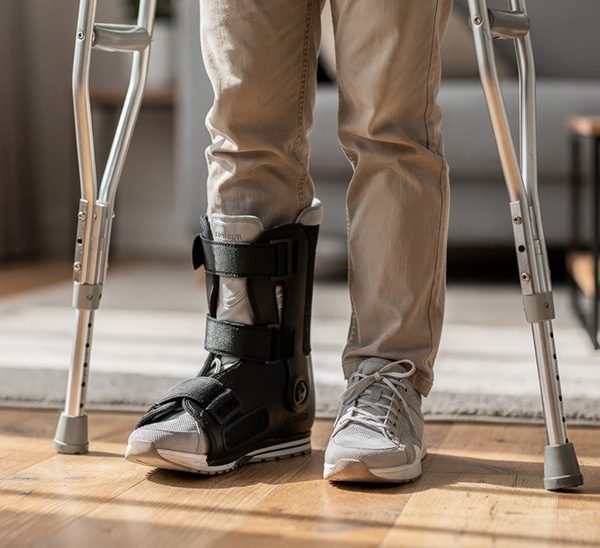
Expect a period of immobilization in a splint, cast, or boot, with protected weight and crutches, for roughly the first 2 to 4 weeks, then a walking boot with gradual weight and heel wedges that are lowered over time. Because you are off your feet for a stretch, your surgeon will go over simple steps to lower the small risk of a blood clot, which sometimes includes blood thinners. Physical therapy builds strength back over the following months. Most patients are walking in normal shoes by around 3 months, jogging by 4 to 5 months, and back to full sport by 6 to 9 months. A non-surgical rupture recovery in a boot follows a similar timeline.
After a Tendon Repair or Transfer
Repairs of the posterior tibial, peroneal, or anterior tibial tendons follow the same general shape: a period protected in a boot or cast, then a gradual return to weight and a rehab program. When the surgery also involves bone work, such as a flatfoot reconstruction, the protected period runs longer.
Getting Back to Activity
Driving returns once you are out of the boot on the right foot, off strong pain medication, and in control of the foot. Desk work usually comes back well before work on your feet. Your surgeon will give you a timeline built around your specific tendon, repair, and job rather than a generic estimate.
Your surgeon will give you a specific timeline at the consultation. Tendon problems that occur alongside foot and ankle arthritis may be managed together.
Why Patients Across Southwest Michigan Choose Kalamazoo Foot Surgery
Most podiatry offices in the Kalamazoo area have one surgeon. Kalamazoo Foot Surgery has five. Every one is a Fellow of the American College of Foot and Ankle Surgeons (FACFAS), podiatry’s highest credential in foot and ankle surgery. For a sudden injury like an Achilles rupture, that depth means the practice can usually get you seen quickly, when timing matters most.
The practice has served Kalamazoo since 1978. Patients come in from across Southwest Michigan, including Portage, Battle Creek, Mattawan, Texas Township, Plainwell, Richland, Galesburg, and Paw Paw, for tendon care that ranges from a rehab plan to a complex repair, close to home.

Dr. Rick Tiller
DPM, FACFAS
Foot & ankle surgery since 1991

Dr. Andrew Robitaille
DPM, FACFAS
Forefoot & reconstructive rearfoot surgery

Dr. Douglas Brewer
DPM, FACFAS
26+ years of experience

Dr. Elizabeth Horton
DPM, FACFAS
Reconstructive surgery, trauma & sports

Dr. Jessica Patterson
DPM, FACFAS
Wound care
What Our Patients Say
Frequently Asked Questions
Schedule Your Tendon Evaluation
How you move forward depends on what you are dealing with.