
Serving Southwest Michigan since 1978
Foot and Ankle Arthritis Treatment in Kalamazoo, MI
Non-surgical care first. Surgery when it is needed. Modern treatment for arthritis in your big toe, midfoot, ankle, or anywhere arthritis is slowing you down.

What Is Foot and Ankle Arthritis?
Arthritis is the wearing down of the cartilage that cushions your joints. The most common type is osteoarthritis, the wear-and-tear form that develops with age. When the cartilage wears thin, the joint surfaces start grinding against each other. That causes the joint pain, stiffness, and loss of range of motion arthritis patients describe.
Your foot has 33 joints. Your ankle has another major joint where your leg meets your foot. Any of them can develop arthritis. The most common spot is the big toe joint, followed by the middle of the foot. The ankle joint develops arthritis less often, but when it does, it can be very limiting. Because your feet have many small joints close together, arthritis in one often puts extra stress on the joints around it.
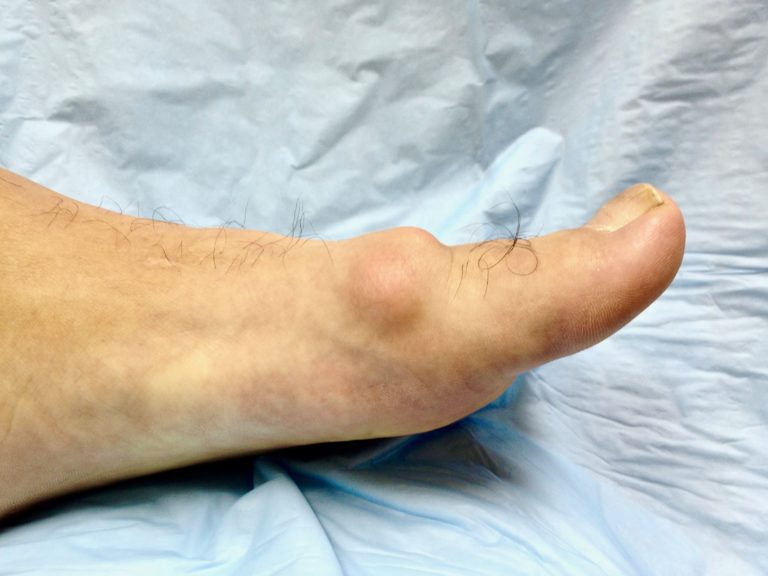
Where Arthritis Shows Up in the Foot and Ankle
Not all arthritis is the same. The location and the cause both matter for treatment. Here are the forms we most often treat.
Big Toe Arthritis (Hallux Rigidus)
The most common form of foot arthritis. The big toe joint loses range of motion, which makes walking and pushing off painful. The joint often becomes enlarged on top, which can be confused with a bunion.
Midfoot Arthritis
Pain in the middle of the foot, often along the top. Develops after old foot injuries or years of wear, especially in patients who have spent a career on their feet.
Ankle Arthritis
Less common than foot arthritis but more limiting when it shows up. Most often follows old ankle injuries: a bad sprain decades ago, a fracture, repeated rolling. Walking, stairs, and uneven ground get harder over time.
Rheumatoid and Psoriatic Arthritis
Arthritis from an autoimmune disease, where the immune system attacks the joint lining. Often affects multiple joints in both feet at once. Needs care from both a rheumatologist for the disease and a foot specialist for the joint damage.
Gout
Caused by uric acid crystals building up in a joint. Most often hits the big toe first, with sudden, severe pain that can wake you up at night. Manageable with medication and diet, but joint damage builds over time with repeated attacks.
Post-Traumatic Arthritis
Arthritis that develops in a joint years after an injury to that joint. Common in former athletes and people with old ankle fractures, dislocations, or sprains that never quite healed right.
Bunion or Big Toe Arthritis? How to Tell the Difference
These two get confused a lot because both can cause a bump near the big toe joint. Knowing which you have changes the whole treatment plan.
It is possible to have both at the same time. X-rays sort it out clearly. If you are not sure which is causing your pain, that is exactly what a consultation can answer.
You’ve Probably Already Tried…
Most patients walking into a foot and ankle arthritis consultation have already tried some version of this list:
These conservative treatments help. They are worth trying. Many patients keep their arthritis manageable for years with the right mix. But none reverse the cartilage wear that has already happened. They manage symptoms while the joint continues to wear.
When to See a Foot and Ankle Specialist
Not every aching joint needs a specialist. But here is when it is time to make the appointment:
Treatment Options for Foot and Ankle Arthritis
We start with the least invasive options that fit your case and escalate only if those stop working. Surgery is the last step, not the first.
Most patients improve with these:
For inflammatory arthritis like rheumatoid or psoriatic, the underlying disease is treated by your rheumatologist with medication. We work alongside that treatment for the joint care.
When non-surgical care has been tried and arthritis is still limiting your life, surgery becomes the next step. The right one depends on which joint, how badly it is worn, and your activity goals.
Joint cleaning and bone spur removal (debridement). For early-stage arthritis where some healthy cartilage remains, the surgeon removes bone spurs and worn tissue to give the joint room to move. For some ankle and large-joint cases, this is done with an arthroscope, a small camera that lets the surgeon see inside through tiny incisions, called arthroscopy. Recovery is the fastest of the surgical options.
Joint replacement (arthroplasty). The worn parts are replaced with an implant, and motion is preserved. Best for certain joints and patients. Total ankle replacement is one example, used for severe ankle arthritis when the patient wants to keep motion.
Joint fusion (arthrodesis). The bones on either side of the worn joint are fused so they no longer move. The pain ends because the joint cannot grind anymore. The trade-off is that the joint will not bend. For the big toe or midfoot, most patients adjust well and walk comfortably. For other joints, replacement may be better.
Realigning the bones. When arthritis is on one side of the joint more than the other, the surgeon can shift the bones to take pressure off the worn side. This can preserve the joint for years.
Your surgeon will walk you through which option fits your case at the consultation.
What to Expect After Surgery
Recovery varies more for arthritis surgery than for many other foot surgeries. The procedure determines the timeline. The timelines below are typical and depend on the joint and the repair.
After Joint Cleaning or Spur Removal
Outpatient procedure, home the same day. Walking in a protective surgical shoe begins right away or within a few days. Back in normal shoes within 4 to 6 weeks. Full activity in 2 to 3 months for most.
After Joint Replacement
Outpatient or a short hospital stay depending on the joint. Protected walking in a boot or cast for a few weeks. Gradual return to walking shoes over 6 to 12 weeks. Full return to most activities, especially low-impact ones like walking, swimming, and cycling, by 3 to 6 months. The joint keeps its motion, which most patients prefer.
After Joint Fusion
Outpatient or an overnight stay. Recovery is longer than the other options. Walking with a cast or boot for the first 6 to 8 weeks, sometimes staying off the foot, especially for midfoot or ankle fusions. Walking comfortably by 3 to 6 months. The fused joint will not bend, but the pain is gone. Most patients say the trade-off is worth it.
After Bone Realignment
Similar to joint fusion in bone healing. Protected walking for several weeks, then a gradual return to normal shoes. Full activity in 3 to 4 months.
Your surgeon will give you a timeline at the consultation, based on the procedure and your health.
Why Patients Across Southwest Michigan Choose Kalamazoo Foot Surgery
Kalamazoo Foot Surgery is built around a simple idea: the right treatment depends on the patient, not the practice. Five foot and ankle surgeons work here, each a Fellow of the American College of Foot and Ankle Surgeons (FACFAS), podiatry’s highest credential in this area. Together, we cover the full range of foot and ankle care, from a guided conservative plan to a straightforward procedure to complex surgery.
With several surgeons and modern techniques under one roof, your plan is matched to your condition and your goals, using the approaches most likely to get you back to the activities you want. The practice has served Kalamazoo since 1978. Patients drive in from across Southwest Michigan, including Portage, Battle Creek, Mattawan, Texas Township, Plainwell, Richland, Galesburg, and Paw Paw.

Dr. Rick Tiller
DPM, FACFAS
Foot & ankle surgery since 1991

Dr. Andrew Robitaille
DPM, FACFAS
Forefoot & reconstructive rearfoot surgery

Dr. Douglas Brewer
DPM, FACFAS
26+ years of experience

Dr. Elizabeth Horton
DPM, FACFAS
Reconstructive surgery, trauma & sports

Dr. Jessica Patterson
DPM, FACFAS
Wound care
What Our Patients Say
Frequently Asked Questions
Schedule Your Foot and Ankle Arthritis Consultation
How you move forward depends on where you are.